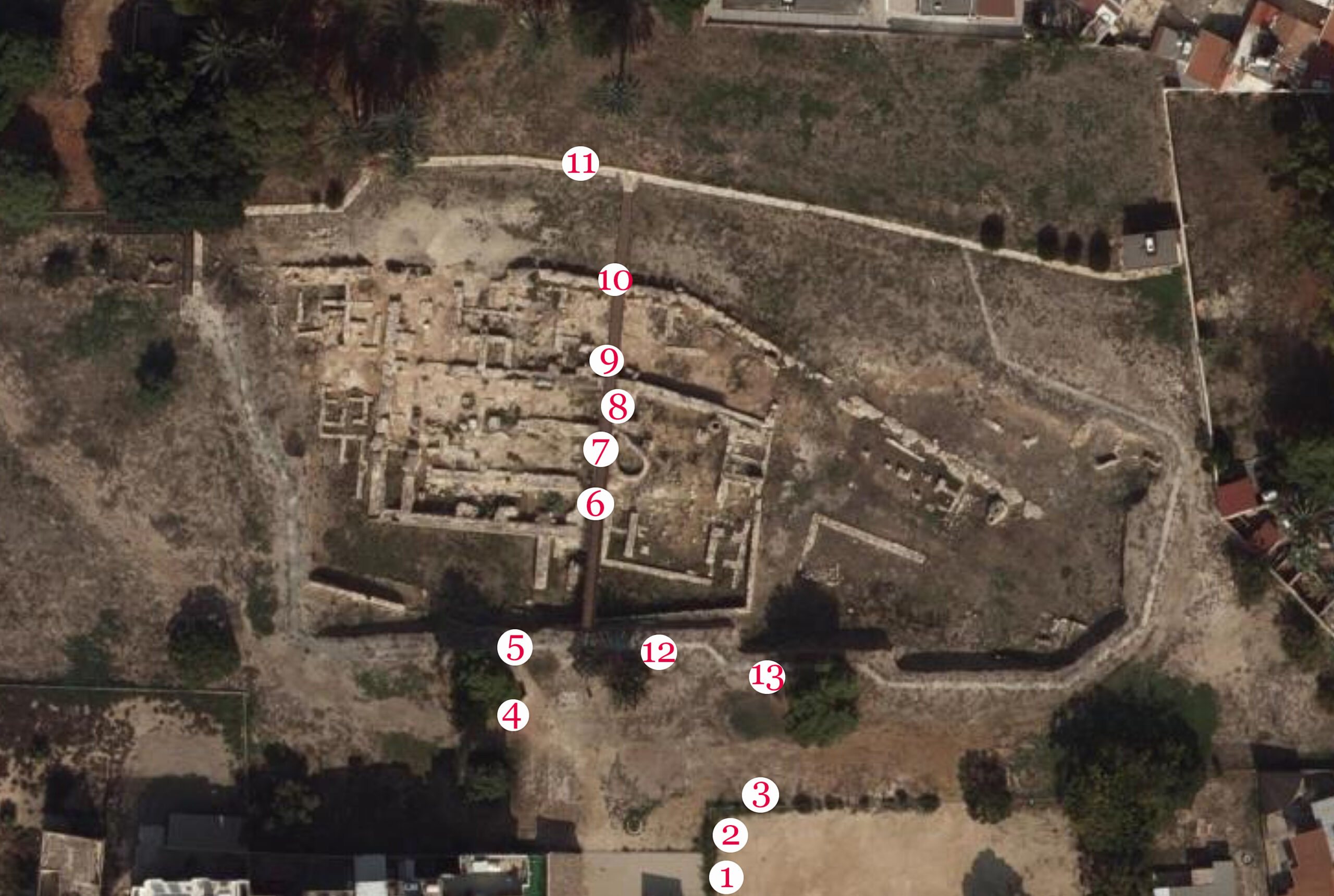
DESCRIPTION:
During the 9th century BC, when Kition became a Phoenician colony, Temple 1 underwent some alterations and was reused as a sanctuary of the Phoenician goddess Astarte, the oriental equivalent of Cypriot Aphrodite. In an inscription on a bowl, found on the earliest floor of the temple, reference is made to Astarte, verifying that the sanctuary was dedicated to her.
The Phoenician retained the exterior walls of the earliest temple (in red as no.1), but made several alterations in the interior arrangement. The Holy-of-Holies was preserved, but two rectangular freestanding pillars were erected, on either side of its central entrance (one of them is shown in green as no.2). These pillars recall the biblical pillars of the Temple of Solomon in Jerusalem. Along the interior courtyard rows of pillars supported porticos. The internal arrangement changed four times during the period 850-312 BC. Stone bases of pillars during the first phase (850-800 BC) are shown in green as no.3, while the column bases of the following phase are shown in yellow as no.4 (800-650 BC).
A rectangular basin hewn in the natural rock (in blue as no.5) belongs to the earliest phase of Temple 1, dating to the 12th century BC. It could have been used as a “sacred lake” containing “sacred fish”, as in Egyptian temples.