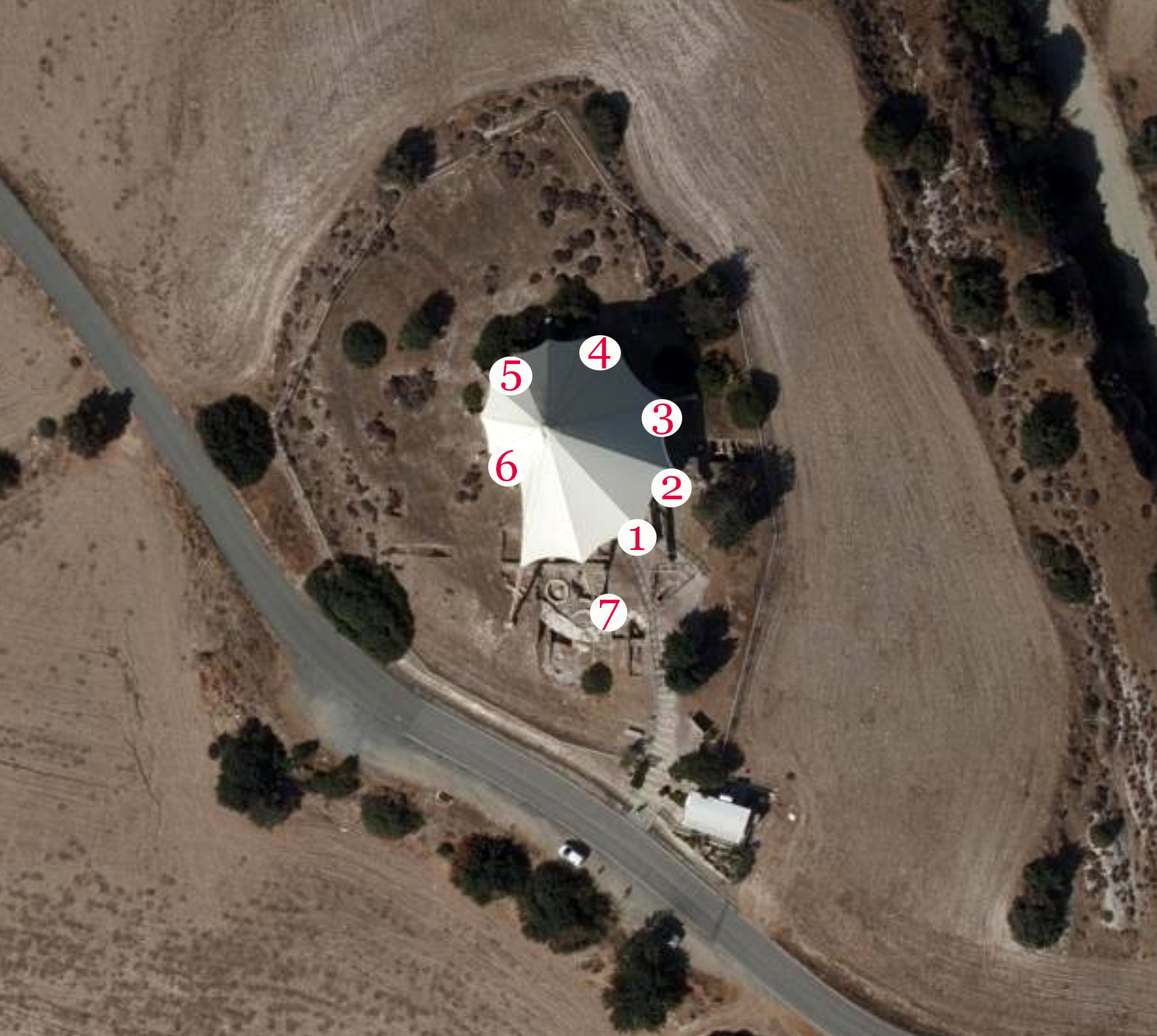
DESCRIPTION:
A NEOLITHIC VILLAGE
The site was initially excavated on a small scale by the Department of Antiquities in 1947. From 1976 through 1984 a more thorough excavation was undertaken by a foreign archaeological mission, the Vasilikos Valley Project.
The site of Kalavasos-Tenta comprises a small village of the Aceramic Neolithic period, strategically located at an easy crossing point of the Vasilikos river. The architecture may be dated in general terms to the period 7500-5500 BC., but the initial use of the site probably occured somewhat earlier when wooden structures may have been built at the top of the hill. The settlement seems to have been peacefully abandoned for reasons unknown. The village is probably somewhat earlier in date than the nearby site at Choirokoitia, although the precise relationship is uncertain.
THE HOUSES
The circular houses of the village, built of stone and mud-brick, cluster on the upper part of a natural hill; at least for part of its duration, the settlement was surrounded by a substantial stone wall, probably with a mudbrick superstructure, and a ditch cut in the natural limestone outside the wall. The roofs of the domestic buildings may have been variously flat or domed, and the internal piers in some of the buildings probably served to support an upper wooden floor. Most of the structures were probably domestic in nature. A complex of structures on the west side of the top of the site may also have been of special significance.
THE PEOPLE
The inhabitants of the village, perhaps numbering no more than 150, grew wheat, barley, and lentils in nearby fields, and they also collected wild plants from the surrounding region. They kept domestic sheep, goats and pigs (but not cattle), and deer were extensively hunted. Containers were made of stone (metal and pottery were unknown) and probably wood and reeds. Various types of stone were also used for domestic utensils and items of personal adornment. The dead were buried in pits below the floors of the buildings or in open areas outside, generally without any accompanying grave goods. Artefacts from the site are on display in the Cyprus Museum, Nicosia and in the Archaeological Museum of the Larnaka District.
THE SHELTER OVER THE SITE
Following the discovery of the well-preserved mud-brick structures on the site, it became imperative to construct some form of permanent shelter to preserve the mud-brick from weathering. A metal-framed structure was erected in 1980, but this was replaced by the present more ambitious scheme in 1995.
The present roof was designed by Dr. Martin Schmid, architect of the French School at Athens, in conjuction with the Department of Antiquities, the Leventis Foundation and the excavator, Dr. Ian A. Todd. The project was financed jointly by the Department of Antiquities and the Anastasios G. Leventis Foundation in Nicosia.
Following the construction of the protective roof, the wall tops of the Neolithic buildings were consolidated by a skilled team from the Department of Antiquities. The visitor will easily be able to differentiate between the recently plastered wall tops and the underlying original Neolithic masonry.