DESCRIPTION:
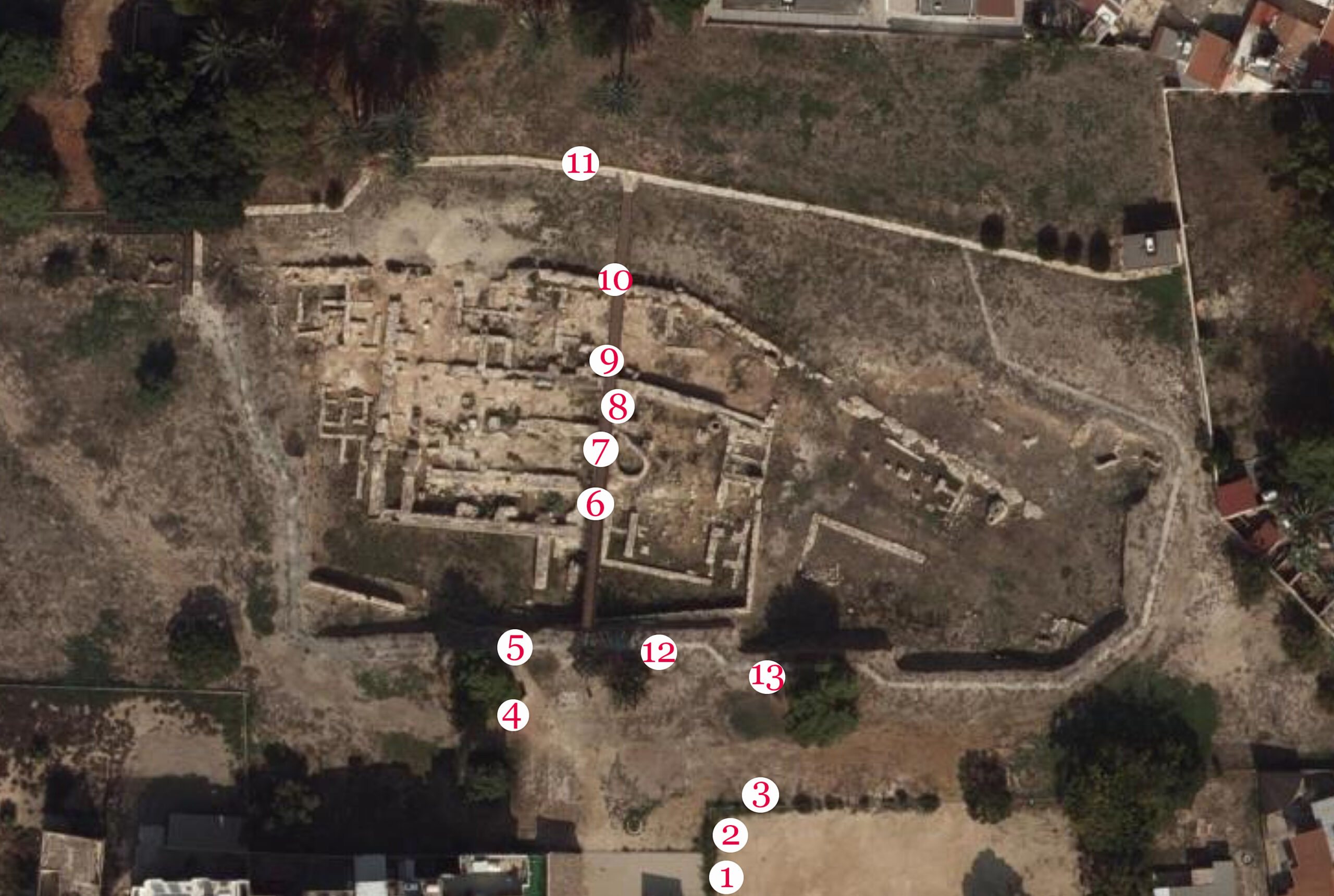
This area was excavated by the Department of Antiquities between 1959 and 1981. The results of this excavation, in combination with the finds from four other areas (Kition I, III, IV and Pamboula) have enhanced our knowledge of the history of the ancient town of Kition considerably. The remains consist of the northern part of the ancient town and part of the defensive wall dating from the 13th century BC. Habitation continued up to the Hellenistic period. The artefacts from the excavations of the area are kept in the Larnaka District Museum.
Area II during the Late Bronze Age
In the 13th century, an important religious centre was founded in this part of the ancient town, next to the defensive wall. Around 1200 BC, an ambitious architectural project redesigned the entire area, with new impressive sanctuaries and a stronger defensive wall. The Cypriot Great Goddess, predecessor of Aphrodite, was worshipped in the most monumental sanctuary of the site.
The arrival of the Achaeans
New cultural elements appearing between 1200 and 1000 BC (personal objects, pottery, new architectural forms and ideas) are interpreted as indications of significant political changes and the arrival of the Achaeans, the first Greek colonists of Kition.
The area during the Iron Age
During the Iron Age Kition was one of the most important Cypriot City-Kingdoms (11th – 4th centuries BC). During the 9th century BC, Kition became a Phoenician colony.
Between 1000 and 850 BC, the use of this area was not so intense. After about 850 BC, the sanctuaries were rebuilt and reused by the Phoenicians. The great temple of the previous phase was still the most significant structure. The Phoenician goddess Astarte, equivalent to the Cypriot Great Goddess – Aphrodite, was worshipped there.
Towards the end of the 4th century BC, the Cypriot City-Kingdoms were dissolved and the Phoenician dynasty of Kition was abolished. Following these events, this area lost its religious character.