DESCRIPTION:
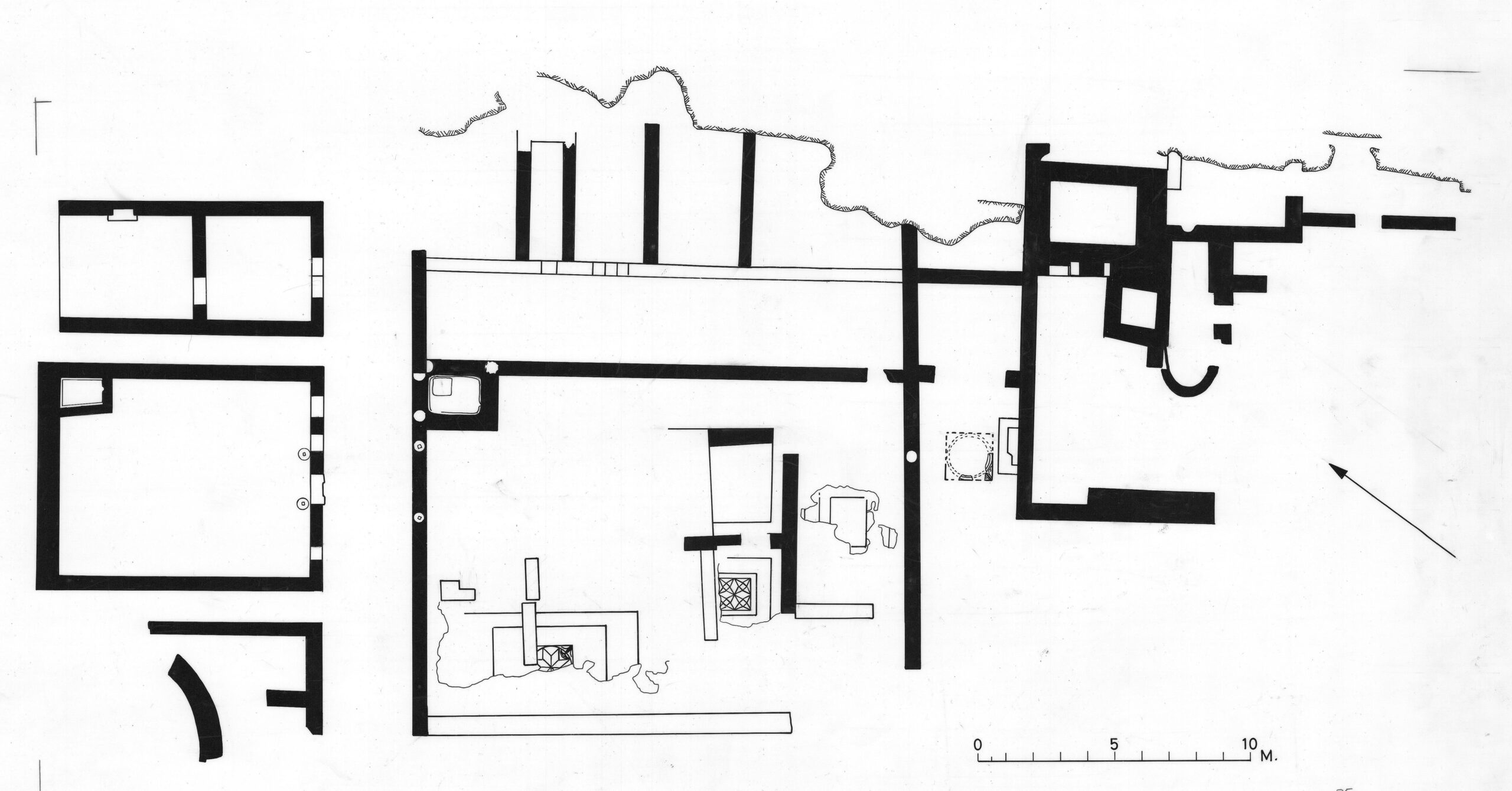
The so-called House of the Gladiators was a luxurious building that functioned as a patrician’s house equipped with its own private bath. It is named after the gladiatorial representations that adorned one of its mosaic floors.
The building consists of two sections:
A) A complex of rooms surrounding a central courtyard. The courtyard is surrounded by porticos to the east, north, and west, while the entire southern part of the complex has collapsed towards the slope. These porticos are bordered by rooms. Dominant among the rooms is a large space that was likely used as a reception area or dining room, accessed through three doors from the western portico. The north part of the building, consisting of a series of narrow rooms, rests against the natural rock.
B) A bath complex in the easternmost part. The complex includes the apodyterium (changing room), frigidarium (cold bath), tepidarium (like-warm bath), and caldarium (hot bath). The cross-shaped hot bath (caldarium), identified by the surviving pilae (small columns that supported the raised floor) of the hypocaust (underfloor heating system), features a rectangular and a semicircular bathing pool in the western and southern arms, respectively. The furnace (praefurnium) is located west of the caldarium, part of which is carved into the natural rock.
The house was built in the second half of the 3rd century AD and destroyed by the earthquake of the 4th century AD. It was reoccupied after some time, but its architectural plan was altered with crude divisions, often built over the mosaic floors.